The Raspberry Pi sat in a drawer for eleven months
Bought in September 2025, nothing achieved for a year. What changed after that was not the hardware — and the reorder date gives away the day.
On 10 September 2025 I bought a Raspberry Pi 5 starter kit. Eight gigabytes, a 128 GB card, the official power supply, the official case with a fan, a heatsink, a cable. The complete, sensible, well-reviewed package.
Then nothing happened for eleven months.
Not quite nothing. An evening here and there. Operating system on, one socket connected, a bit of clicking around. And then the same point every time: the next step would have needed a decision I could not make, and the evening was over.
This article is about what was different afterwards. It was not the hardware.
Written up on 10.11.2026. This text sits at the start of the blog because this is where everything began. It was written a year later — only then was it clear what those eleven months had been about.
What “got nowhere” looks like from the inside
From the outside it looks like laziness. From the inside it looks like this:
You read a guide. It fits 80 per cent. The missing 20 per cent is exactly where you are standing — a different version, a different device, a field that does not exist on your screen. You search on and find three forum posts with three different answers, two of them from 2019.
You pick one. It does not work. And now you do not even know whether the decision was wrong or only the execution.
The problem was never that I had no guide. The problem was that nobody was there to answer the next question at ten in the evening.
A device in a drawer is rarely a hardware problem. Usually it is a problem of the next question.
What changed
In August 2026 I tried again — this time with one difference: Claude was attached directly to the instance through a local bridge. Not as a text window I paste error messages into, but with access to the actual state of the system.
The difference is not “faster answers”. The difference is that nobody has to guess what things look like on my side any more.
| before | with the bridge |
|---|---|
| “there should be a field there” | it reads whether the field is there |
| guide for version X | the state of the version that is running |
| retyping the error message | the message is already there |
The chain itself was not free either. It needed a Python environment of its own, because two libraries did not get along at their respective versions, and an access token that does not show up in process lists. It was verified with two small test scripts, not with a feeling.
On 9 August 2026 Merano was up. The whole story is here — including the quotation mark that cost half a day.
The reorder gives away the day
I could now claim that it ran from then on. There is a better way to show it:
| Date | what happened |
|---|---|
| 10.09.2025 | starter kit bought |
| … | eleven months |
| 09.08.2026 | Merano is up |
| 25.08.2026 | two more Pi 5 kits ordered |
| 28.08.2026 | Vienna is up |
| 29.08.2026 | Kapfenberg is up |
Eleven months of a device doing nothing. Then sixteen days to the order of two more — and three days after that, the second flat was running.
Nothing about the hardware was different. The same Pi that achieved nothing for eleven months still carries the Merano installation today.
Buying the next device because the last one will not run is buying past the bottleneck.
What I bought differently the second time
The order of 25 August had three parts, and the composition says more than any recommendation could:
Two complete Pi 5 kits with NVMe — metal case, active cooler, an adapter board for an M.2 SSD, a 27-watt power supply. For Vienna and Kapfenberg, and from the start without a memory card as the system drive.
And, ordered separately: a PCIe-to-M.2 board from Geekworm and a case from GeeekPi that takes the official active cooler and has room on top for exactly that board.
The second package was for the old Pi. And it says something about the first one: the official case is good until you want to add an expansion board. Then you need a different one. The starter kit was complete — for a build I did not end up keeping.
Why that turned out to be the right call
The memory card in Merano did not die with a bang, it died slowly: two lost long-term statistics and four corrupted database files before it was clear what was going on. Moving to the SSD then cost a whole day, much of which I spent looking at the wrong end.
The two kits for Vienna and Kapfenberg had the right board from the start. Those two installations never experienced the story at all.
| Merano | Vienna and Kapfenberg | |
|---|---|---|
| system drive initially | memory card | NVMe SSD |
| data loss from it | twice | none |
| rebuild needed | yes, with a case change | no |
This is not praise for my foresight. I did not buy the NVMe kits because I foresaw the card dying, I bought them because they were offered as a bundle. It was right anyway.
What I would advise
- Do not buy the second device while the first one does nothing. The bottleneck is almost never where you place the reorder.
- Use an SSD as the system drive from the start. A memory card does not die loudly, it dies as gaps in your data that you notice months later.
- Check whether an expansion board fits before buying a case. The official case is lovely and ends precisely there.
- Find someone for the next question. A forum answers the question from 2019. You need the one from tonight, about your state.
- Keep the old memory card. A bootable system in a drawer is the cheapest rescue path there is.
- Write down what you tried, even when it fails. The eleven months are undocumented, and that is exactly why I cannot say today what each attempt failed on.
So what?
It would be a comfortable story if the Pi had been too weak or the card too slow. Then you could have bought something.
The honest version is less comfortable: the device was fine the entire time. What was missing was someone to tell me that the field in the guide is called something else in my version — before I spend the evening on it.
Eleven months in a drawer and sixteen days to the reorder are the same story seen from two sides. The difference between them was not a component.
If you want to follow this: use RSS
No newsletter. You give me no address, I keep no list, and nobody has to agree to anything to learn that an article is finished. RSS is the older and, for both sides, the more honest solution.
How it works, and why no newsletter
- 1Get a feed reader. No account needed with an app on your phone or a browser extension; use a hosted service if you prefer.
- 2Add the address above to it.
- 3Done. New articles turn up in your reader by themselves — unread stays unread, and nothing lands between invoices and ads in your inbox.
Why that is better: your reader fetches the file. I get no address and cannot see who reads or whether anyone opened it. Unsubscribing means deleting the entry — no link, no confirmation mail, no me.
Related
Flatness was the proof — two lines, two wrong suspects
Two radio links, two months of measurement. In Kapfenberg the culprit was my own automation, in Merano the measuring tool itself.
For thirteen hours the shut-off hung on the cloud
A network outage, two new addresses — and the local path to both water valves was dead. Why fixed addresses matter most when you work locally.
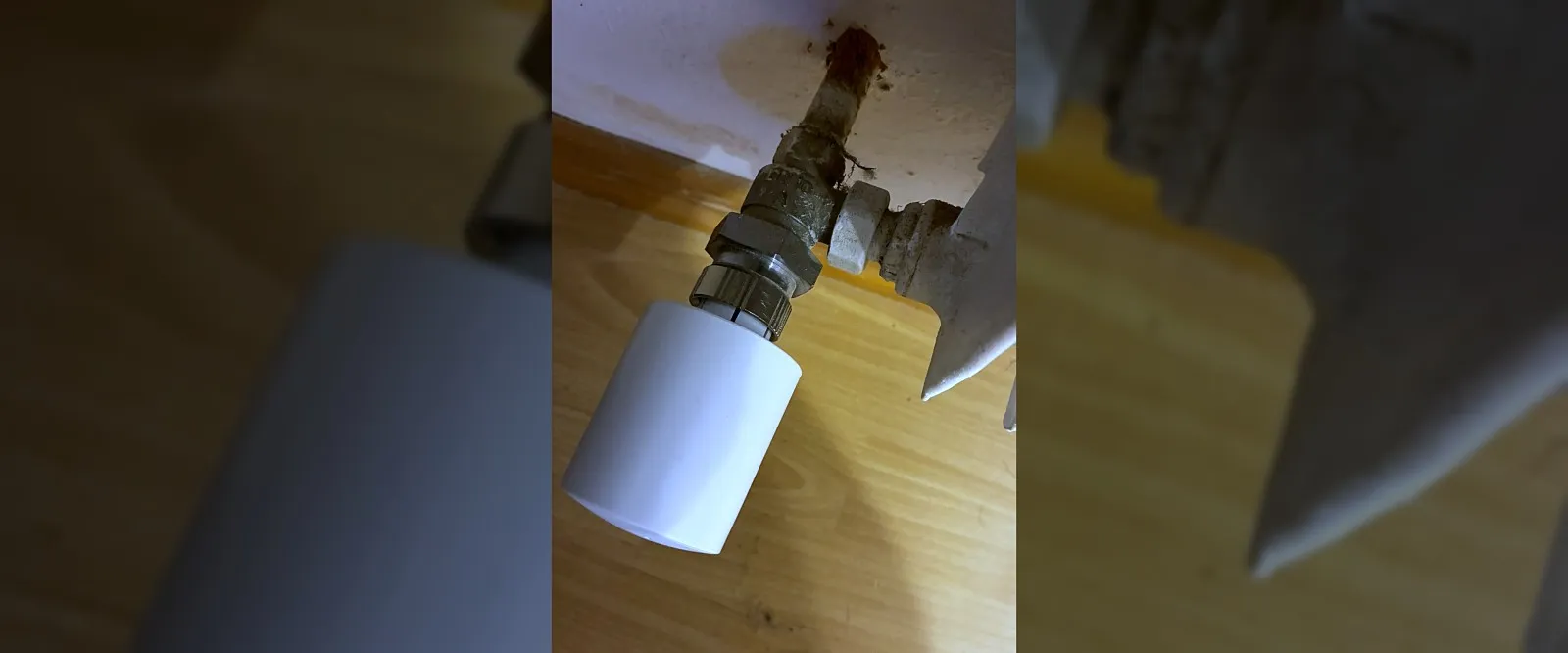
What a radiator thermostat measures is not your room
Three homes, three ways to a radiator: tado over HomeKit, Shelly over Zigbee, and once no valve at all. What each gives you — and what none of them can do.