What a radiator thermostat measures is not your room
Three homes, three ways to a radiator: tado over HomeKit, Shelly over Zigbee, and once no valve at all. What each gives you — and what none of them can do.

In my three homes the radiators hang off three different technologies. In Vienna tado over HomeKit, in Merano Shelly valves over Zigbee, in Kapfenberg no valve at all — there the radiators hang off switching actuators.
That was not planned. Three times it was the obvious answer to a different starting position, and that is exactly why it shows what such a head actually does.
Let us start with the sentence that cost me the most.
The sensor sits in the wrong place
A radiator thermostat measures the temperature where it sits — that is, on the radiator. The hottest point in the room.
Measured on a head that reports both values:
| measured | |
|---|---|
| room sensor | 27.6 °C |
| valve sensor | 34.9 °C |
Seven kelvin apart. And Home Assistant shows the valve sensor.
The consequence is uncomfortably concrete: a head set to hold 21 °C measures the waste heat of its own radiator, decides it is done and closes — while the room sits at 18 °C. That is not a fault, that is the design.
For anything involving room temperature, use a separate sensor. Frost warning, cool-down model, presence logic — all of it belongs on a sensor that is not stuck to a radiator.
That is also what the proof in another article rests on: the real room sensors there disproved an interpretation that looked plausible from the heating values.
The good heads have a countermeasure, and it is the single most important feature of all: you can feed them a temperature from outside. The head then controls against your room sensor instead of its own.
What such a head actually does — and what it does not
It replaces the manual knob. Underneath sits a motor that pushes the same pin you would otherwise turn with your fingers. That is all it is.
Three things follow that it cannot do:
- It does not make the water warmer. If the flow is cold, a fully open valve is exactly as cold as a closed one.
- It does not override house rules. In Merano the building’s heating runs from 15:00 to 22:30 according to the notice in the stairwell. Outside that, no thermostat can achieve anything — which is why the calendar does the pre-heating there, not the temperature.
- It does not help with underfloor heating, nor on radiators without a valve body. What has no knob gets no head.
That sounds banal. It is the most common reason somebody is disappointed after fitting one.
Three homes, three ways
| Vienna | Merano | Kapfenberg | |
|---|---|---|---|
| Technology | tado over HomeKit | Shelly BLU TRV over Zigbee | no valve, switching actuator |
| Count | 8 heads, 4 room thermostats | 6 heads | 2 radiators |
| Bridge needed | yes, its own bridge | Zigbee coordinator | no, Wi-Fi |
| Battery level | no | yes | n/a |
| Valve position | no | yes, 0–100 % | n/a |
| Heating demand | no | yes | n/a |
| External temperature input | no | yes | n/a |
| Consumption measurable | no | no | yes, watts and kWh |
Three columns, and none is better throughout.
Vienna: convenient, local, and two blind spots
Twelve thermostats in Vienna, connected without an account and without a subscription. That works, and it is more than many manufacturers allow.
It is paid for with two things. Among 61 entities there is not a single battery sensor — on this path tado does not publish the level. That makes “unavailable” the only warning, and it arrives too late. And the devices are named after model and serial number, not after rooms.
The whole setup, including six weeks of misdiagnosis, is in its own article. Here only the comparison counts: what the convenient path gives you is a target temperature and a current temperature. Nothing else.
Merano: fourteen entities per valve
Same question, different answer. Each of the six heads brings fourteen entities. Most are trimming; four are not:
| Value | what it is good for |
|---|---|
| Valve position | 0 to 100 %. Shows whether the head really works or merely claims to be controlling. |
| Heating demand | How far the controller wants to open. The most honest answer to “is this room calling for heat”. |
| Calibration state | Whether the head knows the travel of the valve pin. Without it, it regulates blind. |
| External temperature | The input for your real room sensor — the answer to the problem at the top. |
Plus battery level, minimum and maximum setpoint, a temperature offset for trimming, and a manual mode.
The inventory of 23.10.2026: six valves, all calibrated, batteries full across the board.
The difference to Vienna is not control quality. It is that you can look up why a room stays cold.
Calibration: the part no brochure mentions
A new head does not know how far your valve can move. So it travels the whole range once and memorises the stops. That is the calibration, and it is the most common source of trouble during installation.
Three of my six heads read “not calibrated”. The calibration run started every time, the motor turned, and at the end the same error stood there.
The numbers settled it:
| Valve | steps travelled |
|---|---|
| Bedroom wall | 1,071 |
| Kitchen | 1,143 |
| Child’s room | 1,187 |
Three independent defects do not produce an identical number. Equal to within about one per cent — that is not coincidence, that is an aborted search: the head looks for the stop on the valve pin, fails to find it within its search window, and gives up.
So the cause was mechanical, not electronic. Not the gateway — each had one working and one failing head. Not the firmware — the same version ran in both groups. Not wear — a head with 335,000 steps failed exactly like one with 2,638.
What remains is the connection to the valve: adapter loose, wrong adapter, or the valve pin sits too far back.
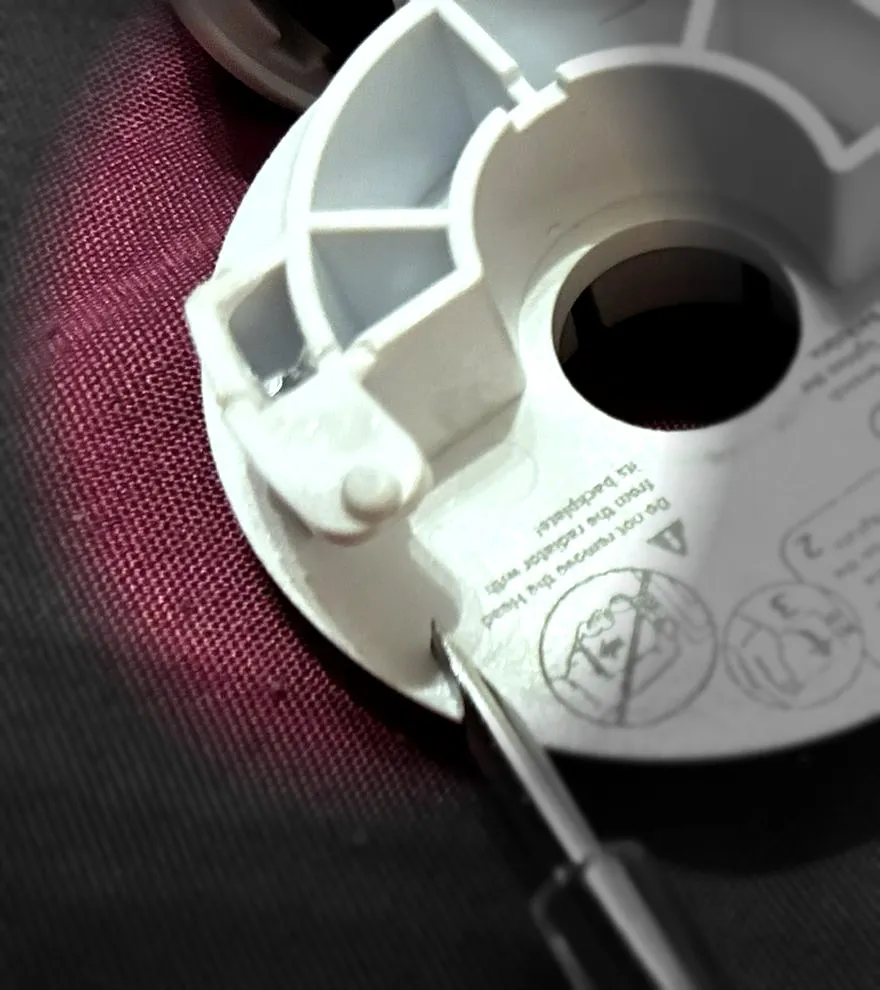
This is where the whole question sits: the ring has to seat firmly on the valve, and the plunger in the middle has to actually reach the valve pin. Neither is visible from outside once the head is screwed on.
The test that settles it costs nothing: put a failing head on a radiator where one works, and vice versa. If the fault stays with the radiator, it is the mechanics. If it travels with the head, it is the head.
A fourth head was even clearer: step counter zero. The motor had never run. Setpoint 39.8 °C against a measured 34.8 °C, three minutes of waiting — position stayed at 0 %. The setpoint arrived at the device, the motor did not move. That is not a radio problem.
Two traps in operation, both stepped into personally
Do not recalibrate a head that works. I sent the command as a batch across all six. The living-room head had been running faultlessly and afterwards read “not calibrated” — a second run did not help. What brought it back was fresh batteries; its cells were the oldest in the house.
The step counter starts at zero after a battery change. That explains apparent resets in older measurement series — and it means the number says nothing about the age of the valve, only about the time since the last change.
Plus a third quirk that is not a fault: the heads sleep. There is no wake command. They report by themselves roughly every five minutes, and immediately afterwards they accept commands. Written blind it fails, written three seconds after a report it works — both measured.
The summer exercise
A valve that stays closed from May to October seizes up. So once a week it opens and closes again.
Explicitly not a calibration — see above. Just open, hold briefly, close.
Two things belong to it, otherwise it is worthless:
- Mind the order. The valve position can only be set in manual mode. First manual mode on, then 100 %, then 0 %, then manual mode off. Otherwise the device refuses — with an error message that looks like a radio problem.
- Report when a head does not join in. If one stays silent for fifteen minutes it is skipped and a message goes out. Maintenance that runs silently into nothing is worse than none.
And Kapfenberg, where no valve hangs at all
There, two electric radiators hang off switching actuators with power metering. No head, no valve, no battery.
What you gain: you see what the device consumes — in watts, in real time, and at month’s end in kilowatt-hours. No thermostat in the world can do that, because a valve knows nothing about the heat flow it lets through.
What you lose: all control. A switching actuator knows on and off. The temperature is the appliance’s own business, and what it thinks while doing it stays its secret.
The only safeguard at this point is a timed switch-off, inside the actuator itself — so a radiator does not run on because an automation failed. That sits in the device, not in the system, and therefore survives a Home Assistant outage too.
What I would advise
- Do not measure room temperature with the thermostat. It sits on the radiator and measures the radiator. Seven kelvin of difference is normal.
- Buy a head you can feed an external temperature to. That is the one feature that repairs the design flaw.
- Ask about the battery sensor before buying — not whether the device has a battery, but whether the path you intend to use reports the level.
- Check the calibration state after fitting, not just whether something moves. A head that travels 1,100 steps and then stops looks from the outside like one that works.
- Swap two heads against each other before you start thinking about defects. The test takes five minutes and answers the only question that matters.
- Leave working heads alone. A batch action across all devices is convenient and cost me a set of batteries.
- Exercise the valves over the summer — once a week open and closed, with an alert when one does not join in.
So what?
After three homes I would ask the question differently than at the start. Not “which thermostat is best”, but: what do you want to be able to see when a room stays cold?
In Vienna I see target and actual. If it does not warm up, I do not know whether the head is shut, whether it is uncalibrated, or whether no hot water is arriving. In Merano I see all three answers separately.
In Kapfenberg I see something neither of them can show: what it costs.
The valve itself does the same thing everywhere. It pushes a pin in. The difference is not how well it controls — it is how much of that it tells you.
If you want to follow this: use RSS
No newsletter. You give me no address, I keep no list, and nobody has to agree to anything to learn that an article is finished. RSS is the older and, for both sides, the more honest solution.
How it works, and why no newsletter
- 1Get a feed reader. No account needed with an app on your phone or a browser extension; use a hosted service if you prefer.
- 2Add the address above to it.
- 3Done. New articles turn up in your reader by themselves — unread stays unread, and nothing lands between invoices and ads in your inbox.
Why that is better: your reader fetches the file. I get no address and cannot see who reads or whether anyone opened it. Unsubscribing means deleting the entry — no link, no confirmation mail, no me.