The current clamp sat differently from the plan
One meter in the distribution box, two clamps — and the assignment was swapped. A lamp proved it, its own reading only 1.2 watts away.
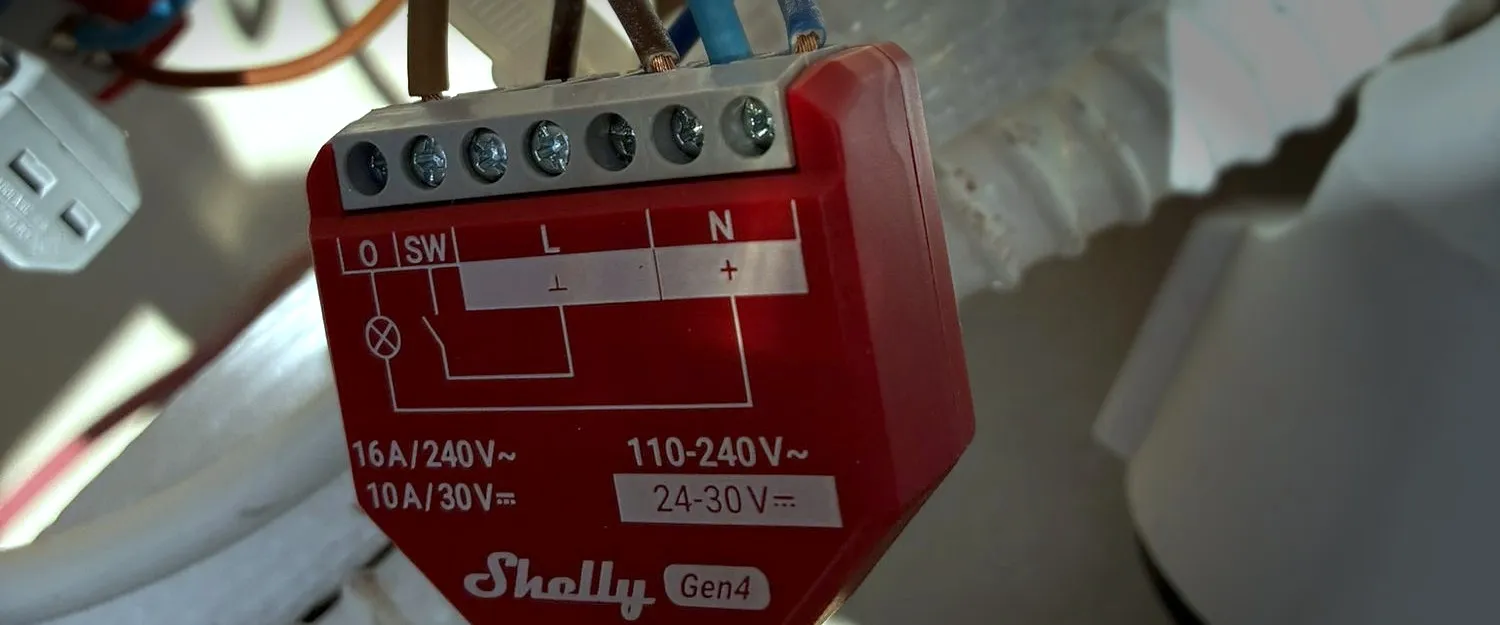
Since 13 August there has been a meter with two current clamps in the distribution box of the Merano flat: one around the heavy-current circuit, one around the lighting circuit. Together they give total consumption.
The plan said clamp 1 measures the lighting. In fact it is the other way round.
That is no catastrophe — you swap two labels and you are done. What is interesting is how it came to light, because the same test answered two further questions.
The proof was a lamp
Two checks, and the second is the nicer one:
| Check | Channel 1 | Channel 2 |
|---|---|---|
| 900 W load switched on | ~1000 W | 107 W |
| Balcony light on — 84.6 W per its own actuator | −0.4 W | +85.8 W |
The lamp hangs on a Shelly of its own that measures its power. So there was a number to check against.
The jump sits unambiguously on channel 2, and it differs from the lamp’s own reading by 1.2 watts.
That settles three things at once:
- The assignment. Channel 2 is the lighting, not channel 1.
- The accuracy. 1.2 watts out of 85 — the clamps measure what they should.
- The direction. The jump is positive.
The third point is the one easily overlooked:
A current clamp mounted the wrong way round measures correctly and reports it with the wrong sign. Look only at the magnitude and you will never notice.
And the trap I had expected was not there
Two clamps in one box can easily enclose the outgoing and return path of the same circuit. Each then shows the same current, and the sum is double the real consumption — an error that never gets noticed because everything looks plausible.
Checked: the two channels diverge independently (1012 against 106 watts), and the lighting jump appeared on only one of them. Were they two sides of one circuit, both would have to show the same thing.
So the sum really is total consumption. That was an assumption before and is a measurement now.
Two device generations, two protocols
The meter is a first-generation device and speaks a transport of its own, not the newer interface of the other Shellys in the house. Out of the factory its receiver is set to broadcast, which likes to stall — so it gets entered explicitly.
And there a trap is hiding that left me baffled:
wrong:   /settings/coiot?peer=<address>    silently does not accept the value
right:   /settings?coiot_peer=<address>
The first call answers with HTTP 200 and dutifully returns the complete settings. Except the value in them is still empty afterwards.
A
200is a statement about the request, not about the effect. After writing, read back what is actually stored.
That is the same lesson as the empty error message that reported an installation as failed in Kapfenberg although it had gone through — only with the sign reversed: there the failure lied, here the success did.
What actually mattered at purchase — and it was not the current rating
Two 16-amp switching actuators were ordered, one of them replacing a smaller 8-amp one at the air conditioner.
The obvious justification would be headroom. The 8 amps were never the problem — that had been calculated beforehand.
The real gain lies elsewhere: the larger actuator switches by button press between three operating modes — five presses, then three minutes of pairing time:
| Mode | |
|---|---|
| Matter | factory setting |
| Wi-Fi | local interface, Shelly integration |
| Zigbee | as a radio node in the Zigbee network |
On the small model, Zigbee only works through an alternative firmware image — and that replaces the Wi-Fi firmware completely. Gone would be the local interface, the integration and every script in this project that addresses the device. The way back is only through the app over Bluetooth.
Only one mode at a time. Choose Zigbee and you lose Wi-Fi for that device. For an air conditioner that is inconsequential — it is then controlled and measured over the other path.
The point is not the air conditioner. The point is that on both devices a Zigbee radio node can be activated at any time without giving anything up. That is precisely the reserve for the weakest radio link in the house — the one to the thermostat head at the bedroom window.
So what was bought was not current rating but an open option.
Three things about the swap, all learned the hard way
First check who depends on the entity. Searched through the relationship query and by text search across the whole configuration directory: no automation, no script, no package, no dashboard. Only the device table in the documentation names it.
Write the name onto the device, not only into Home Assistant. Otherwise the two drift apart at the next reload. That is exactly what an earlier mess hung on, where bathroom and living room were swapped — and it was only so stubborn because both names were right somewhere and wrong somewhere else.
The energy counter starts at zero. The previous 53.7 kWh remain as a truncated series in the dashboard. That is not an error, but it looks like one if you are not expecting it.
In passing: the energy dashboard changed its schema
In the current version a grid source no longer takes a list form for inflow and outflow, but the counter directly — one source per counter. The old form is rejected with “extra keys not allowed”.
The same change cost me an evening in Vienna. The second time it was one line.
What I’d suggest
- Verify the assignment instead of taking it from the plan. A load you switch on and off answers the question in two minutes.
- Use a load that knows its own power. Then one measurement checks assignment, accuracy and direction at once.
- Watch the sign. A clamp mounted backwards is the error that hides best.
- Rule out the doubling trap. Two clamps on the same circuit produce doubled numbers that look entirely plausible.
- After writing, check what was actually stored. A
200only proves the request arrived. - Buy the open option, not the bigger number. For me the gain was not the current rating but an operating mode I do not even need yet.
So what?
The meter has measured correctly since day one. The only thing that was wrong was what the plan said — and the plan was mine.
That is the recurring pattern in this project: it is not the devices that are off, but the assumption about what they are currently doing. A clamp sits where somebody fitted it, not where it is drawn.
And the two minutes it took to switch on a lamp answered three questions, two of which I had not even asked.
If you want to follow this: use RSS
No newsletter. You give me no address, I keep no list, and nobody has to agree to anything to learn that an article is finished. RSS is the older and, for both sides, the more honest solution.
How it works, and why no newsletter
- 1Get a feed reader. No account needed with an app on your phone or a browser extension; use a hosted service if you prefer.
- 2Add the address above to it.
- 3Done. New articles turn up in your reader by themselves — unread stays unread, and nothing lands between invoices and ads in your inbox.
Why that is better: your reader fetches the file. I get no address and cannot see who reads or whether anyone opened it. Unsubscribing means deleting the entry — no link, no confirmation mail, no me.
Related
50 cubic metres out — and still counting correctly
My gas meter has two data sources: an accurate one days behind, and a current one with a wrong starting value. Only together are they worth anything.
My flat tells me the electricity bill in advance
At 23:50 on the last day of the month a notification arrives with consumption, cost components and the expected bill. What the forecast can do and where it ends.
The power nets out, the energy does not
The house meter measures three phases. It nets the power against itself but adds the energy up — which makes its counters useless for the dashboard.